卷七·第 337–343 问 恒星高度、夜间求时、星的升落、均齐十二宫与河宽
夜里改测恒星高度求上升与已过之时,求一星升落的时刻,用曲时线均齐十二宫,由别的角求上升,以及量河宽。
§337. How is the altitude of the fixed stars found?
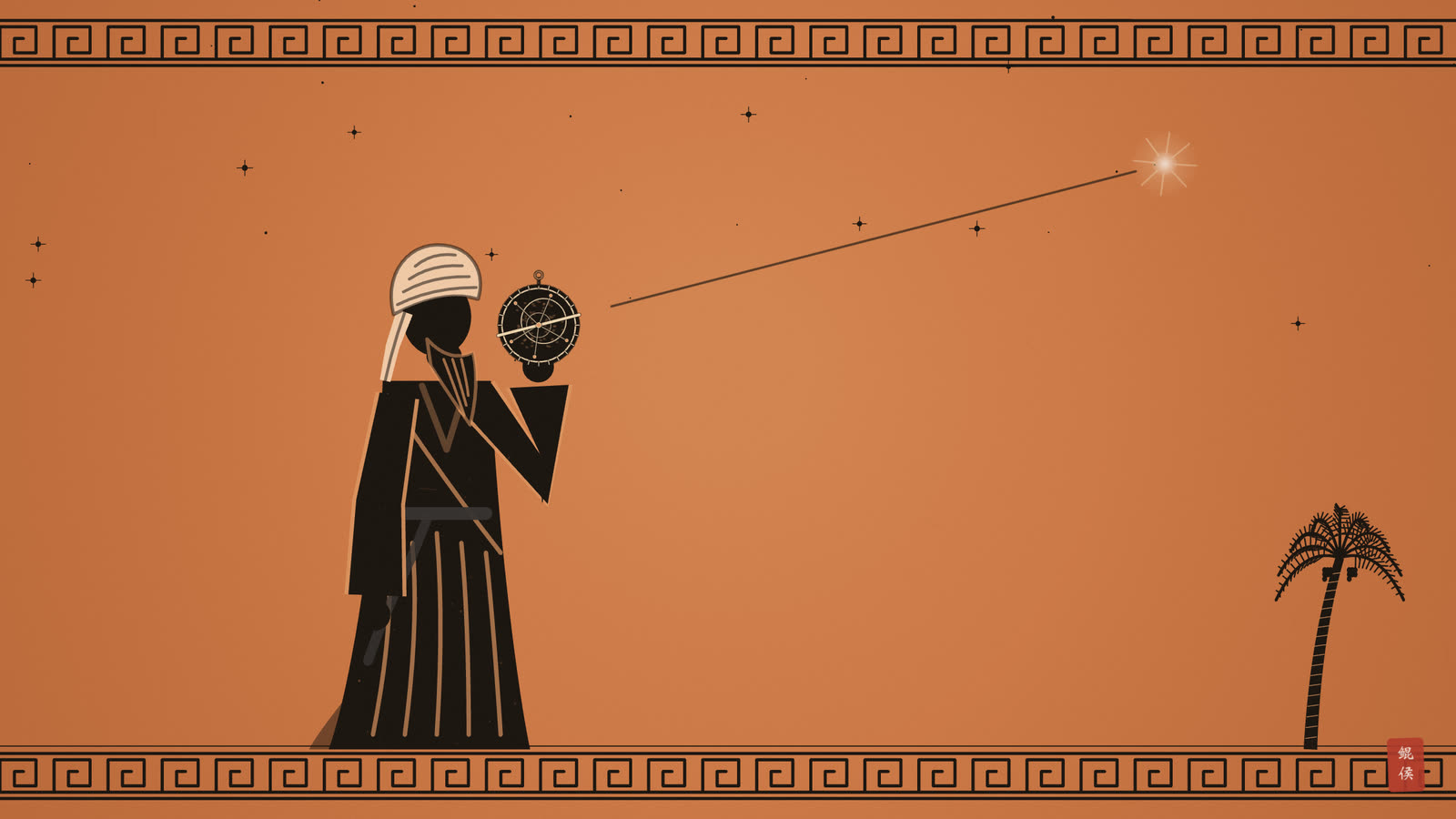
Choose one of them that is fixed on the spider and face it, and hang the astrolabe from your right hand, hanging down freely; then the quadrant of altitude will necessarily face the star, provided that its back is toward you. Then raise and lower the alidade, looking with one eye through the hole of the lower 'brick', until you happen to see that star through both holes of the two bricks. When that happens, look at the pointer of the alidade, at how many of the parts of altitude it has fallen: that is the altitude of that star. Then find out its direction with respect to the meridian line, whether it is east of it or west of it.
翻译点开
§337. How is the altitude of the fixed stars found?
第三百三十七问 怎样求恒星的高度?
Choose one of them that is fixed on the spider and face it, and hang the astrolabe from your right hand, hanging down freely; then the quadrant of altitude will necessarily face the star, provided that its back is toward you. Then raise and lower the alidade, looking with one eye through the hole of the lower 'brick', until you happen to see that star through both holes of the two bricks. When that happens, look at the pointer of the alidade, at how many of the parts of altitude it has fallen: that is the altitude of that star. Then find out its direction with respect to the meridian line, whether it is east of it or west of it.
在蛛网上标定了的恒星中选一颗,面向它,用右手提起星盘,让它自由下垂;只要背面朝着你,高度象限就必然对着那颗星。然后升降照准尺,用一只眼从下面那块“砖”的孔里望去,直到恰好透过两块砖的两个孔看见那颗星。这时看照准尺的指针落在高度的多少份上:那就是那颗星的高度。然后弄清它相对于子午线的方向,是在它以东还是以西。
大意与图解点开
🔎 大意:选一颗蛛网上有星针的恒星,提盘下垂,用一只眼透过两孔望见它,照准尺所指即其高度;并记下它在子午线东还是西。
📖 术语
| 术语 | 英文原词 | 意思 |
|---|---|---|
| 恒星 | the fixed stars | 蛛网上有星针者 |
| 砖 | 'brick' | 照准尺上的觇板 |
| 子午线 | the meridian line | 分东西的南北线 |
🧭 图解与讲解
夜里没有太阳,就改测恒星。做法与测太阳一样,只是对准的方式不同:太阳刺眼,是让光从上孔落到下孔;星光微弱,要用一只眼从下孔望出去,直到透过两个孔看见那颗星(表一)。
| 测太阳(第三百三十问) | 测恒星(本问) | |
|---|---|---|
| 对准的办法 | 上板的影子盖住下板,光从上孔落到下孔 | 用一只眼从下孔望,透过两孔看见星 |
| 读数 | 照准尺尖头在高度象限上 | 同左 |
| 还要记下 | 扎瓦勒前为东,后为西 | 在子午线以东还是以西 |
| 可选的星 | — | 只能用蛛网上有星针的星 |
能用的只有蛛网上有星针的那些星,因为下一步要把这颗星的星针放到地平纬圈上。比鲁尼还要求记下星在子午线以东还是以西,道理与太阳的“东方、西方高度”一样:同一个高度,升起途中与落下途中各出现一次。
§338. How do you find the ascendant from it?
Put the pointer of that star, which is its sharpened tip on the spider, on the like of the altitude you found for it among the almucantars of the east if the altitude was eastern, and among the almucantars of the west if it was western. Then look at the horizon of the east: what part of the zodiac meets it is the sign of the ascendant with its degrees. And look at the degree of the Sun, where it has fallen among the crooked hours: those are your hours.
§339. How is what has passed of the night found?
When the ascendant has been put on the horizon of the east, make a mark at the place of the pointer on the ḥujra. Then turn the spider backwards, toward the left, until the opposite of the degree of the Sun meets the horizon of the east, and see how far the pointer has moved along the ḥujra: that is the revolved part. Then turn it into hours, as was said before.
翻译点开
§338. How do you find the ascendant from it?
第三百三十八问 你怎样由它求上升点?
Put the pointer of that star, which is its sharpened tip on the spider, on the like of the altitude you found for it among the almucantars of the east if the altitude was eastern, and among the almucantars of the west if it was western. Then look at the horizon of the east: what part of the zodiac meets it is the sign of the ascendant with its degrees. And look at the degree of the Sun, where it has fallen among the crooked hours: those are your hours.
把那颗星的星针,也就是它在蛛网上削尖的尖头,放在与你为它测得的高度相同的地平纬圈上:高度若是东方的,就在东方地平纬圈中,若是西方的,就在西方地平纬圈中。然后看东方地平:黄道带与它相遇的部分,就是上升星座及其度数。再看太阳的度数落在曲时之中的哪里:那就是你的时数。
§339. How is what has passed of the night found?
第三百三十九问 怎样求夜间已过了多少?
When the ascendant has been put on the horizon of the east, make a mark at the place of the pointer on the ḥujra. Then turn the spider backwards, toward the left, until the opposite of the degree of the Sun meets the horizon of the east, and see how far the pointer has moved along the ḥujra: that is the revolved part. Then turn it into hours, as was said before.
把上升点放在东方地平上以后,在指针于围垣上的位置作个记号。然后把蛛网向左倒转,直到太阳度数的对冲点与东方地平相遇,看指针沿着围垣移动了多远:那就是已转之度。然后照前面所说,把它化为小时。
大意与图解点开
🔎 大意:把星针放在该星高度的地平纬圈上,东方地平即上升点,太阳所落曲时即夜里时数;倒转到太阳对冲点升起,得夜间已过的时度。
📖 术语
| 术语 | 英文原词 | 意思 |
|---|---|---|
| 星针 | the pointer of that star | 星在蛛网上的尖头 |
| 已转之度 | the revolved part | 指针在围垣上所走 |
| 向左 | toward the left | 倒转的方向 |
🧭 图解与讲解
由恒星求上升,与上一章由太阳求上升如出一辙,只是把“太阳的度数”换成“星针的尖头”:把那颗星的星针放到它高度的那条地平纬圈上,东侧或西侧照测得的方位,这时东方地平上的黄道度数就是上升点(图一上行)。因为恒星在蛛网上的位置是固定的,星的高度一定,整个天球的转角也就定了。
〔图〕夜里用恒星:星针放上它的高度圈,东方地平就是上升点
同时看太阳的度数落在地平以下哪两条曲时线之间,就直接读出夜里是第几个曲时。白天太阳在地平以上,曲时线读不到它,才要借对冲点(第三百三十五问);夜里太阳本身就在曲时线的区域,所以直接看太阳。
求夜间已过的等时:记下指针的位置,把蛛网向左倒转,直到太阳的对冲点回到东方地平,也就是退回到日落的那一刻;指针走过的时度就是已转之度,每十五时度一小时(图一下行)。这与第三百三十三问白天求已过之时完全对称,只是起点由日出换成了日落。
📖 术语
| 术语 | 英文原词 | 意思 |
|---|---|---|
| 星针 | the pointer of that star | 星在蛛网上的尖头 |
| 已转之度 | the revolved part | 指针在围垣上所走 |
| 向左 | toward the left | 倒转的方向 |
🧭 图解与讲解
由恒星求上升,与上一章由太阳求上升如出一辙,只是把“太阳的度数”换成“星针的尖头”:把那颗星的星针放到它高度的那条地平纬圈上,东侧或西侧照测得的方位,这时东方地平上的黄道度数就是上升点(图一上行)。因为恒星在蛛网上的位置是固定的,星的高度一定,整个天球的转角也就定了。
同时看太阳的度数落在地平以下哪两条曲时线之间,就直接读出夜里是第几个曲时。白天太阳在地平以上,曲时线读不到它,才要借对冲点(第三百三十五问);夜里太阳本身就在曲时线的区域,所以直接看太阳。
求夜间已过的等时:记下指针的位置,把蛛网向左倒转,直到太阳的对冲点回到东方地平,也就是退回到日落的那一刻;指针走过的时度就是已转之度,每十五时度一小时(图一下行)。这与第三百三十三问白天求已过之时完全对称,只是起点由日出换成了日落。
§340. How is the time of the rising and the setting of a star found, by night and by day?
Put its sharpened tip on the horizon of the east, then look at the degree of the Sun. If it is above the earth, in the region of the almucantars, the rising of that star will be by day; so make a mark at that moment at the place of the pointer on the ḥujra, then turn the spider backwards until the degree of the Sun meets the horizon of the east. What the pointer has moved of the parts of the ḥujra is the revolved part; turn it into hours, and they are what has passed of the daytime up to the time of the rising of the star. If the degree of the Sun is beneath the horizon, in the region of the hours, the rising of that star will be by night; so make a mark at the place of the pointer on the ḥujra, and turn the spider backwards until the opposite of the degree of the Sun meets the horizon of the east. Then what the pointer has moved is the revolved part; turn it into hours, and they are what has passed of the night up to the rising of the star. If you want the like of this for its setting, use the horizon of the west instead of the horizon of the east, and follow in the rest of the work exactly what we have described, until you obtain the circumstances of its setting.
翻译点开
§340. How is the time of the rising and the setting of a star found, by night and by day?
第三百四十问 怎样求一颗星在夜里或白天升起与落下的时刻?
Put its sharpened tip on the horizon of the east, then look at the degree of the Sun. If it is above the earth, in the region of the almucantars, the rising of that star will be by day; so make a mark at that moment at the place of the pointer on the ḥujra, then turn the spider backwards until the degree of the Sun meets the horizon of the east. What the pointer has moved of the parts of the ḥujra is the revolved part; turn it into hours, and they are what has passed of the daytime up to the time of the rising of the star. If the degree of the Sun is beneath the horizon, in the region of the hours, the rising of that star will be by night; so make a mark at the place of the pointer on the ḥujra, and turn the spider backwards until the opposite of the degree of the Sun meets the horizon of the east. Then what the pointer has moved is the revolved part; turn it into hours, and they are what has passed of the night up to the rising of the star. If you want the like of this for its setting, use the horizon of the west instead of the horizon of the east, and follow in the rest of the work exactly what we have described, until you obtain the circumstances of its setting.
把它削尖的尖头放在东方地平上,然后看太阳的度数。若太阳在地上,在地平纬圈的区域里,那颗星的升起就在白天;于是在此刻于指针在围垣上的位置作个记号,然后把蛛网倒转,直到太阳度数与东方地平相遇。指针在围垣的刻度上移动了多少,就是已转之度;把它化为小时,就是到那颗星升起时白昼已过的时数。若太阳度数在地平以下,在时辰的区域里,那颗星的升起就在夜里;于是在指针于围垣上的位置作个记号,把蛛网倒转,直到太阳度数的对冲点与东方地平相遇。那么指针移动的就是已转之度;把它化为小时,就是到那颗星升起时夜间已过的时数。若想求它落下时的同样数据,就用西方地平代替东方地平,其余的做法完全照我们所描述的去做,直到得出它落下时的情形。
大意与图解点开
🔎 大意:星针置东方地平,看太阳在地上或地下,定星升于昼或夜;倒转到日出或日落,指针所走即升起前已过的时数;落下用西方地平。
📖 术语
| 术语 | 英文原词 | 意思 |
|---|---|---|
| 地平纬圈的区域 | the region of the almucantars | 地平以上 |
| 时辰的区域 | the region of the hours | 地平以下 |
| 西方地平 | the horizon of the west | 求落下时用 |
🧭 图解与讲解
这一问求某颗星哪一刻升起或落下。把它的星针放在东方地平上,天球就转到它正好升起的样子;这时看太阳:在地平纬圈的区域(地上)就是白天升起,在曲时线的区域(地下)就是夜里升起(表一)。
| 情形 | 星针放在 | 太阳在 | 倒转到 | 指针所走化为小时 |
|---|---|---|---|---|
| 白天升起 | 东方地平 | 地平纬圈区(地上) | 太阳度数到东方地平 | 升起前白昼已过的时数 |
| 夜里升起 | 东方地平 | 时辰区(地下) | 太阳对冲点到东方地平 | 升起前夜间已过的时数 |
| 白天落下 | 西方地平 | 地平纬圈区(地上) | 太阳度数到东方地平 | 落下前白昼已过的时数 |
| 夜里落下 | 西方地平 | 时辰区(地下) | 太阳对冲点到东方地平 | 落下前夜间已过的时数 |
再倒转蛛网退回日出(白天)或日落(夜里,借太阳的对冲点),指针走过的时度化成小时,就是从日出或日落到这颗星升起的时间。求落下,把星针放在西方地平上,其余照做。
古人观星、定夜间的时刻、看某星何时晨出昏没,都离不开这类计算;用星盘一转,就能算出某星当天在什么时刻升起、落下。
§341. How are the twelve houses equalized?
Put the degree of the ascendant on the horizon of the east; then its opposite, which is the degree of the seventh, meets the horizon of the west. Then look at the meridian line: whatever sign and degrees meet it are those of mid-heaven. By count, the sign of mid-heaven ought to be the tenth from the sign of the ascendant. If what you have found is indeed the tenth from the ascendant, write down its degrees with it, for the angles are upright. When they are inclining, what comes out with the astrolabe is the eleventh sign; so begin the writing for mid-heaven with the tenth by count, say for example Aquarius, then follow it with what was found together with its degrees, so that it becomes 'Aquarius, of Pisces so many degrees'. When the angles are declining, what comes out with the astrolabe is the ninth sign; so begin with the count and say 'Aquarius, of Capricorn so many degrees'. The degrees of the fourth are equal to the degrees of the tenth, and likewise every house and its opposite, and the signs are opposite one another: I mean that if the tenth is Aquarius, the fourth is Leo; if the tenth is 'Aquarius of Pisces', the fourth is 'Leo of Virgo'; and if the tenth is 'Aquarius of Capricorn', the fourth is 'Leo of Cancer'. This is a rule that holds for all the houses once one of them is known. Then turn the spider backwards until the degree of the ascendant goes down beneath the horizon by two crooked hours and comes onto the line of the beginning of the eleventh hour; then look at the meridian line: whatever sign and degree meet it are the sign of the ninth house and its degrees, and its opposite is the sign of the third and its degrees. Then turn it backwards further, until the degree of the ascendant goes down two more crooked hours and comes onto the beginning of the ninth hour; then what meets the meridian line is the sign of the eighth house and its degree, and its opposite is the sign of the second house and its degree. Then put the opposite of the degree of the ascendant on the line of the beginning of the third hour beneath the horizon of the west; then what is on the meridian line is the sign of the eleventh house and its degree, and its opposite is the sign of the fifth house and its degree. Then turn the spider in the direct direction, toward the right, until the opposite of the degree of the ascendant goes down and comes onto the line of the beginning of the fifth hour; then the sign of the twelfth house and its degree meet the meridian line, and the houses are complete and equalized.
翻译点开
§341. How are the twelve houses equalized?
第三百四十一问 怎样均齐十二宫?
Put the degree of the ascendant on the horizon of the east; then its opposite, which is the degree of the seventh, meets the horizon of the west. Then look at the meridian line: whatever sign and degrees meet it are those of mid-heaven. By count, the sign of mid-heaven ought to be the tenth from the sign of the ascendant. If what you have found is indeed the tenth from the ascendant, write down its degrees with it, for the angles are upright. When they are inclining, what comes out with the astrolabe is the eleventh sign; so begin the writing for mid-heaven with the tenth by count, say for example Aquarius, then follow it with what was found together with its degrees, so that it becomes 'Aquarius, of Pisces so many degrees'. When the angles are declining, what comes out with the astrolabe is the ninth sign; so begin with the count and say 'Aquarius, of Capricorn so many degrees'. The degrees of the fourth are equal to the degrees of the tenth, and likewise every house and its opposite, and the signs are opposite one another: I mean that if the tenth is Aquarius, the fourth is Leo; if the tenth is 'Aquarius of Pisces', the fourth is 'Leo of Virgo'; and if the tenth is 'Aquarius of Capricorn', the fourth is 'Leo of Cancer'. This is a rule that holds for all the houses once one of them is known. Then turn the spider backwards until the degree of the ascendant goes down beneath the horizon by two crooked hours and comes onto the line of the beginning of the eleventh hour; then look at the meridian line: whatever sign and degree meet it are the sign of the ninth house and its degrees, and its opposite is the sign of the third and its degrees. Then turn it backwards further, until the degree of the ascendant goes down two more crooked hours and comes onto the beginning of the ninth hour; then what meets the meridian line is the sign of the eighth house and its degree, and its opposite is the sign of the second house and its degree. Then put the opposite of the degree of the ascendant on the line of the beginning of the third hour beneath the horizon of the west; then what is on the meridian line is the sign of the eleventh house and its degree, and its opposite is the sign of the fifth house and its degree. Then turn the spider in the direct direction, toward the right, until the opposite of the degree of the ascendant goes down and comes onto the line of the beginning of the fifth hour; then the sign of the twelfth house and its degree meet the meridian line, and the houses are complete and equalized.
把上升点的度数放在东方地平上;它的对冲点,即第七宫的度数,就与西方地平相遇。然后看子午线:与它相遇的星座与度数,就是中天的星座与度数。按数,中天的星座应当是从上升星座起的第十个。若你所得到的确实是从上升起的第十个,就把它的度数连同它写下,因为这时诸角是直立的。当诸角倾斜时,用星盘得出的是第十一个星座;那就以按数的第十个,比如说水瓶座,开头来写中天,再接着写所得到的星座及其度数,成为“水瓶座、双鱼座若干度”。当诸角偏离时,用星盘得出的是第九个星座;那就以按数的开头,说“水瓶座、摩羯座若干度”。第四宫的度数等于第十宫的度数,每一宫与其对宫都是如此,星座也彼此相对:我是说,若第十宫是水瓶座,第四宫就是狮子座;若第十宫是“水瓶座、双鱼座”,第四宫就是“狮子座、处女座”;若第十宫是“水瓶座、摩羯座”,第四宫就是“狮子座、巨蟹座”。这是一条规则,只要知道其中一宫,就适用于所有各宫。然后把蛛网倒转,直到上升点的度数沉到地平以下两个曲时,到达第十一时起点的那条线上;然后看子午线:与它相遇的星座与度数,就是第九宫的星座及其度数,它的对冲点就是第三宫的星座及其度数。然后再往回转,直到上升点的度数再沉下两个曲时,到达第九时的起点;这时与子午线相遇的,就是第八宫的星座及其度数,它的对冲点就是第二宫的星座及其度数。然后把上升点度数的对冲点放在西方地平以下第三时起点的那条线上;这时子午线上的就是第十一宫的星座及其度数,它的对冲点就是第五宫的星座及其度数。然后把蛛网顺着方向向右转,直到上升点度数的对冲点沉下去,到达第五时起点的那条线上;这时第十二宫的星座及其度数就与子午线相遇,诸宫就齐全而均齐了。
大意与图解点开
🔎 大意:上升置东方地平,子午线上即中天,分直立、倾斜、偏离三种写法;再按曲时线转盘,在子午线上读出九、八、十一、十二宫头。
📖 术语
| 术语 | 英文原词 | 意思 |
|---|---|---|
| 宫位的均齐 | the equalization of the houses | 求十二宫的宫头 |
| 直立的角 | upright angles | 中天恰在第十座 |
| 倾斜的角 | inclining angles | 中天落在第十一座 |
| 偏离的角 | declining angles | 中天落在第九座 |
| 第十一时起点 | the beginning of the eleventh hour | 东方地平下第二条曲时线 |
🧭 图解与讲解
这一问是星盘与占星最直接的接口:求十二宫的宫头。先把上升度数放在东方地平,对冲点自然落在西方地平,就是第七宫;子午线上与宝座同侧的那一度是中天,第十宫;它的对冲点是第四宫(表二)。
| 诸角的情形 | 星盘上中天落在 | 写法(以上升金牛座为例) | 对宫第四宫 |
|---|---|---|---|
| 直立 | 从上升起第十个星座 | 水瓶座若干度 | 狮子座若干度 |
| 倾斜 | 第十一个星座 | “水瓶座、双鱼座若干度” | “狮子座、处女座若干度” |
| 偏离 | 第九个星座 | “水瓶座、摩羯座若干度” | “狮子座、巨蟹座若干度” |
| 宫 | 星盘上的做法 | 在子午线上读到 | 示例 |
|---|---|---|---|
| 第一、七宫 | 上升度数置东方地平 | (东、西地平上) | 天蝎 10°52′ / 金牛 10°52′ |
| 第十、四宫 | 同上 | 子午线近宝座一段 | 狮子 16°28′ / 水瓶 16°28′ |
| 第九、三宫 | 倒转,上升度数沉到东方地平下两个曲时(第十一时起点) | 子午线 | 巨蟹 14°13′ / 摩羯 14°13′ |
| 第八、二宫 | 再沉两个曲时(第九时起点) | 子午线 | 双子 13°21′ / 射手 13°21′ |
| 第十一、五宫 | 上升的对冲点置西方地平下第三时起点 | 子午线 | 处女 14°11′ / 双鱼 14°11′ |
| 第十二、六宫 | 顺转,对冲点沉到第五时起点 | 子午线 | 天秤 12°59′ / 白羊 12°59′ |
比鲁尼接着讲一个写法上的讲究(表一)。按星座计数,中天该是从上升起第十个星座;但由于黄道斜升,星盘上得到的中天可能落在第十一个(诸角“倾斜”)或第九个(诸角“偏离”)星座。这时宫名仍按计数写第十个星座,后面再写实际的星座与度数,例如上升金牛座时,写“水瓶座、双鱼座若干度”。每一宫与其对宫度数相同、星座相对,所以知道一宫就能写出对宫。
其余宫头用地平以下的曲时线来求:把蛛网倒转,让上升度数沉到东方地平下两个曲时,子午线上就是第九宫头;再沉两个曲时,是第八宫头。把上升的对冲点放在西方地平下两个曲时,子午线上是第十一宫头;再沉两个曲时,是第十二宫头。各宫的对宫随之而得。
裁定表核验过这套转法,全部自洽。它的实质是把上升度数在地平以下所走的夜弧三等分,每两个曲时一份,对应一宫。表二按今法算了一个例子:上升天蝎座十度五十二分时,宫头由第八宫的双子座十三度起,逐宫递增,到第十二宫的天秤座十三度,与上升衔接得很平顺。比鲁尼称之为“等分”诸宫,是按时间等分,而不是按黄道度数等分。
§342. How is the ascendant found from another angle?
If what is known is the angle of the setting, put its degree within its sign on the horizon of the west; if it is the angle of mid-heaven, put it on the line of mid-heaven toward the throne (kursī); and if it is the angle of the earth, put it on the line beneath the horizon. Then in all of these look at what meets the east: that is the sign of the ascendant and its degree.
翻译点开
§342. How is the ascendant found from another angle?
第三百四十二问 怎样由另一个角求上升点?
If what is known is the angle of the setting, put its degree within its sign on the horizon of the west; if it is the angle of mid-heaven, put it on the line of mid-heaven toward the throne (kursī); and if it is the angle of the earth, put it on the line beneath the horizon. Then in all of these look at what meets the east: that is the sign of the ascendant and its degree.
若已知的是下降之角,就把它在其星座中的度数放在西方地平上;若是中天之角,就把它放在朝向宝座的中天线上;若是地之角,就把它放在地平以下的那条线上。然后在所有这些情形下看与东方相遇的是什么:那就是上升星座及其度数。
大意与图解点开
🔎 大意:已知下降、中天或地之角,就把它的度数放在西方地平、中天线或子夜线上,东方地平所遇即上升点。
📖 术语
| 术语 | 英文原词 | 意思 |
|---|---|---|
| 下降之角 | the angle of the setting | 第七宫头 |
| 中天之角 | the angle of mid-heaven | 第十宫头 |
| 地之角 | the angle of the earth | 第四宫头 |
🧭 图解与讲解
四个角里任知一个,就能求出上升点:已知第七宫头,就把它放在西方地平;已知中天,就放在靠宝座一侧的中天线上;已知地之角(第四宫头),就放在地平以下的子夜线上。转好以后,东方地平上的就是上升点(表一)。
| 已知的角 | 把它的度数放在 | 然后 |
|---|---|---|
| 下降之角(第七宫) | 西方地平 | 看东方地平所遇,即上升点 |
| 中天之角(第十宫) | 朝向宝座的中天线 | 同上 |
| 地之角(第四宫) | 地平以下的子夜线 | 同上 |
这在实际中很有用:旧书里的星盘有时只记中天,或者问事者只知道某星在中天,凭这一问就能补出上升点,再照上一问求出全部宫头。
§343. Finding the breadth of a river, or a distance on the ground, when something intervenes between the measurer and the measuring of it
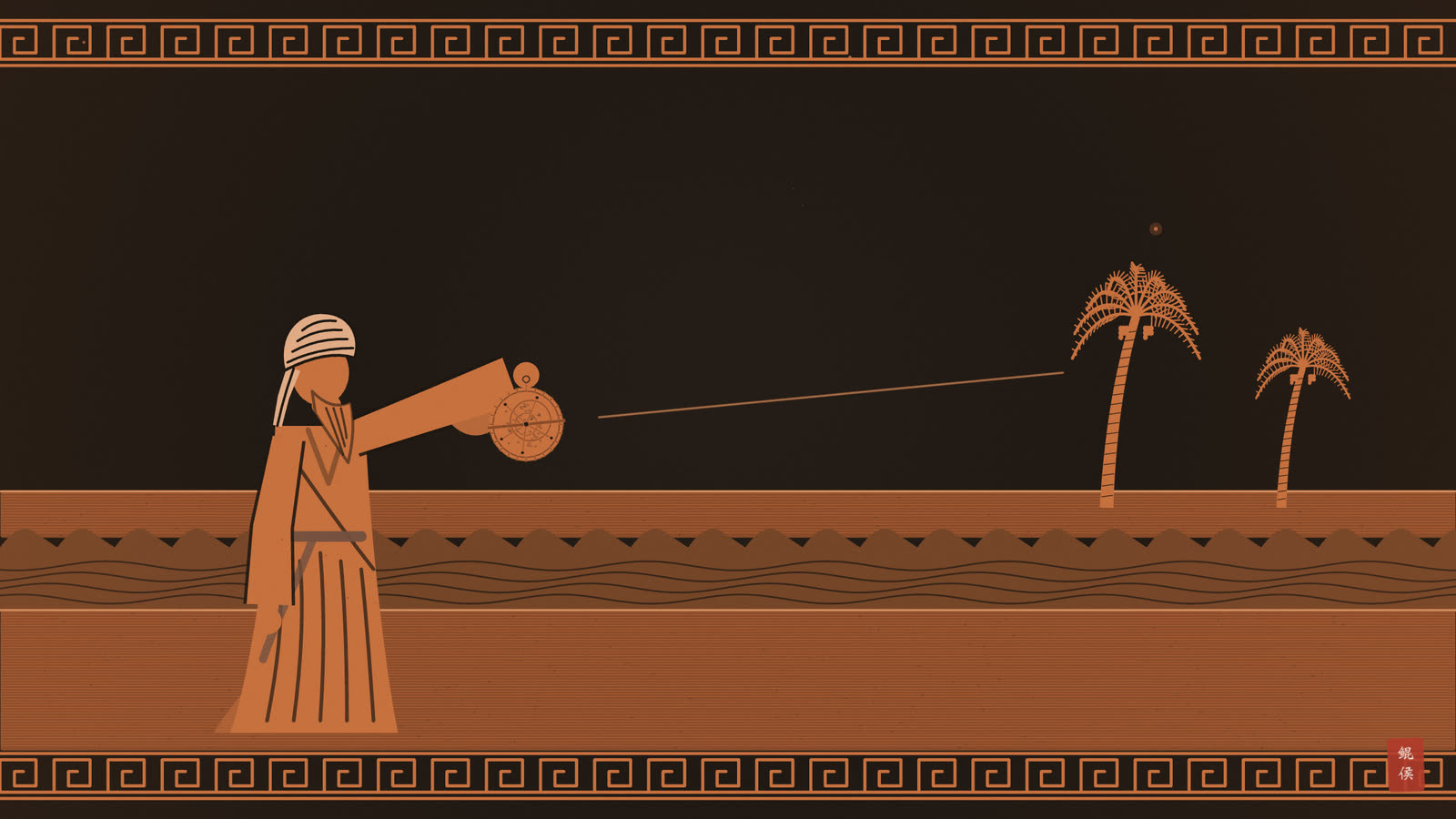
Stand on its bank and hang the astrolabe from your right hand; look with one of your eyes through the hole of the sight next to you, and lower and raise the alidade until you see through both holes of the two sights what faces you on the other bank. Then turn round on yourself where you stand until you face the dry land, the alidade remaining as it was, and look through the holes of the two sights with one of your eyes until your sight falls through them on the ground. Make a mark at the place where your sight ended, and measure what is between where you stand and that mark: whatever it is, that is the breadth of the river. Likewise, if the place whose measure is sought is on the surface of the earth and its open space cannot be reached, put it in the place of the river and its far boundary in the place of the other bank, and do what was said before, until you find its like in distance on the ground, which can be measured.
翻译点开
§343. Finding the breadth of a river, or a distance on the ground, when something intervenes between the measurer and the measuring of it
第三百四十三问 求一条河的宽度,或测量者与所量之物之间有阻隔时求地面上的一段距离
Stand on its bank and hang the astrolabe from your right hand; look with one of your eyes through the hole of the sight next to you, and lower and raise the alidade until you see through both holes of the two sights what faces you on the other bank. Then turn round on yourself where you stand until you face the dry land, the alidade remaining as it was, and look through the holes of the two sights with one of your eyes until your sight falls through them on the ground. Make a mark at the place where your sight ended, and measure what is between where you stand and that mark: whatever it is, that is the breadth of the river. Likewise, if the place whose measure is sought is on the surface of the earth and its open space cannot be reached, put it in the place of the river and its far boundary in the place of the other bank, and do what was said before, until you find its like in distance on the ground, which can be measured.
站在河岸上,用右手提起星盘;用一只眼从靠近你的那块觇板的孔里望去,降低、升高照准尺,直到透过两块觇板的两个孔看见对岸正对你的东西。然后在你所站之处原地转身,直到面对旱地,照准尺保持原样,用一只眼透过两块觇板的孔看去,直到你的视线穿过它们落在地上。在你视线所止之处作个记号,量你所站之处与那个记号之间的距离:不论是多少,那就是河的宽度。同样,若所求量的地方在地面上,而它的空旷处无法走到,就把它放在河的位置上,把它的远端放在对岸的位置上,照前面所说的去做,直到在地面上找到一段与它距离相等、可以量的距离。
大意与图解点开
🔎 大意:照准尺对准对岸后不动,原地转身朝向旱地,视线落地之处到脚下的距离就等于河宽;走不到的地面距离也照此量。
📖 术语
| 术语 | 英文原词 | 意思 |
|---|---|---|
| 河的宽度 | the breadth of a river | 岸到对岸的距离 |
| 旱地 | the dry land | 身后可量的平地 |
| 觇板 | sights | 照准尺上带孔的方片 |
🧭 图解与讲解
从这一问起,比鲁尼转向用星盘量地,也就是卷一几何的实地应用。量河宽的办法极简单:站在岸边,用照准尺对准对岸正对面的一个东西;照准尺不动,原地转身,朝着身后的旱地再望,视线落在地上的那一点到脚下的距离,就是河宽(图一)。
〔图〕量河宽:照准尺对准对岸后原地转身,视线落在旱地的距离与河宽相等
道理是两个全等的三角形:人身之高是共同的一条直角边,照准尺的倾角不变,两条视线与竖直方向的夹角相同,所以两条底边相等。抄本的图画成一个等腰三角形,中间的竖线是身高,左半底边是河宽,右半是平地,正是这个意思。
比鲁尼又推广一句:凡是地面上有阻隔、走不过去的距离,都可以当作“河”来量,在身后可走的平地上找一段等长的距离代替。接下来的一章用同样的思路量井深与塔高。
📖 术语
| 术语 | 英文原词 | 意思 |
|---|---|---|
| 河的宽度 | the breadth of a river | 岸到对岸的距离 |
| 旱地 | the dry land | 身后可量的平地 |
| 觇板 | sights | 照准尺上带孔的方片 |
🧭 图解与讲解
从这一问起,比鲁尼转向用星盘量地,也就是卷一几何的实地应用。量河宽的办法极简单:站在岸边,用照准尺对准对岸正对面的一个东西;照准尺不动,原地转身,朝着身后的旱地再望,视线落在地上的那一点到脚下的距离,就是河宽(图一)。
道理是两个全等的三角形:人身之高是共同的一条直角边,照准尺的倾角不变,两条视线与竖直方向的夹角相同,所以两条底边相等。抄本的图画成一个等腰三角形,中间的竖线是身高,左半底边是河宽,右半是平地,正是这个意思。
比鲁尼又推广一句:凡是地面上有阻隔、走不过去的距离,都可以当作“河”来量,在身后可走的平地上找一段等长的距离代替。接下来的一章用同样的思路量井深与塔高。
原文为公有领域古籍;翻译、印象画与图文解读由 AI 辅助生成,鲲侯审校。