卷一·第 47–62 问 比例诸法、杆秤、立体与圆锥截线
比例论收尾:转比、等比、二重比与复比;再讲形的高、相似三角形、中外比、杆秤,以及立方体、棱柱、圆柱、圆锥与截线。
§47. What is the conversion of a ratio?
It is the ratio of the first to its excess over the second, as the ratio of the third to its excess over the fourth. In our example, if the ratio is inverted so that the second becomes first, it is the ratio of five times; and when it is then converted, as we have said, it is the ratio of five quarters [corrected: MS has 'five times'].
§48. What is ordered equality of ratio?
If the ratio of the first to the second is as the ratio of the third to the fourth, and the ratio of the second to the fifth as the ratio of the fourth to the sixth, and so on for however many there are, then the extremes are proportional by equality of ratio: that is, the ratio of the first to the fifth is as the ratio of the third to the sixth. In our example the ratio of the first to the second is that of a fifth, and the ratio of the second to the fifth is that of a quarter, so the ratio of the first to the fifth is that of a fifth of a quarter, as is the ratio of the third to the sixth; and so it is [corrected: MS has 'the ratio of the second to the fifth is that of a fifth of a quarter, as the ratio of the third to the sixth'].
§49. What is perturbed equality of ratio?
If the ratio of the first to the second is as the ratio of the fourth to the sixth, and the ratio of the second to the fifth as the ratio of the third to the fourth, then, when the middle terms are dropped, the extremes remain proportional: that is, the ratio of the first to the fifth is as the ratio of the third to the sixth. This is called perturbed equality. In our example the ratio of the first to the second is that of a fifth, and the ratio of the fourth to the sixth likewise; the ratio of the second to the fifth is that of a quarter, and the ratio of the third to the fourth likewise. So the ratio of the first to the fifth, which is that of a quarter of a fifth, is as the ratio of the third to the sixth.
翻译点开
§47. What is the conversion of a ratio?
第四十七问 何谓转比?
It is the ratio of the first to its excess over the second, as the ratio of the third to its excess over the fourth. In our example, if the ratio is inverted so that the second becomes first, it is the ratio of five times; and when it is then converted, as we have said, it is the ratio of five quarters [corrected: MS has 'five times'].
它是第一比它超出第二之数,如同第三比它超出第四之数。在我们的例子里,若把比反过来,使第二成为第一,它就是五倍的比;然后再照我们所说的转过来,就是四分之五的比〔抄本作「五倍」,据算改正〕。
§48. What is ordered equality of ratio?
第四十八问 何谓顺序等比?
If the ratio of the first to the second is as the ratio of the third to the fourth, and the ratio of the second to the fifth as the ratio of the fourth to the sixth, and so on for however many there are, then the extremes are proportional by equality of ratio: that is, the ratio of the first to the fifth is as the ratio of the third to the sixth. In our example the ratio of the first to the second is that of a fifth, and the ratio of the second to the fifth is that of a quarter, so the ratio of the first to the fifth is that of a fifth of a quarter, as is the ratio of the third to the sixth; and so it is [corrected: MS has 'the ratio of the second to the fifth is that of a fifth of a quarter, as the ratio of the third to the sixth'].
若第一比第二如同第三比第四,第二比第五如同第四比第六,依此类推,不论有多少项,那么两端的项按等比成比例:就是说,第一比第五如同第三比第六。在我们的例子里,第一比第二是五分之一的比,第二比第五是四分之一的比,所以第一比第五是四分之一的五分之一的比,第三比第六也是如此;事情正是这样〔抄本作「第二比第五是四分之一的五分之一的比,如同第三比第六」,据算改正〕。
§49. What is perturbed equality of ratio?
第四十九问 何谓错序等比?
If the ratio of the first to the second is as the ratio of the fourth to the sixth, and the ratio of the second to the fifth as the ratio of the third to the fourth, then, when the middle terms are dropped, the extremes remain proportional: that is, the ratio of the first to the fifth is as the ratio of the third to the sixth. This is called perturbed equality. In our example the ratio of the first to the second is that of a fifth, and the ratio of the fourth to the sixth likewise; the ratio of the second to the fifth is that of a quarter, and the ratio of the third to the fourth likewise. So the ratio of the first to the fifth, which is that of a quarter of a fifth, is as the ratio of the third to the sixth.
若第一比第二如同第四比第六,第二比第五如同第三比第四,那么去掉中间各项,两端的项仍成比例:就是说,第一比第五如同第三比第六。这叫作错序等比。在我们的例子里,第一比第二是五分之一的比,第四比第六也是如此;第二比第五是四分之一的比,第三比第四也是如此。所以第一比第五,即五分之一的四分之一的比,如同第三比第六。
大意与图解点开
🔎 大意:转比是前项比前项超出后项之数;两组量逐段同比,两端也同比,叫顺序等比;对应次序错开仍成立,叫错序等比。
📖 术语
| 术语 | 英文原词 | 意思 |
|---|---|---|
| 转比 | conversion | 前项比其超出之数 |
| 顺序等比 | ordered equality of ratio | 逐段对应相等 |
| 错序等比 | perturbed equality of ratio | 对应次序错开 |
| 两端 | extremes | 首项与末项 |
| 中间各项 | middle terms | 推导时略去的项 |
🧭 图解与讲解
第四十七问是比的第五种变换「转比」:前项比它超出后项之数。仍用上章的例子一比五,前项小于后项,没有超出可言,所以先反比成五比一,五超出一为四,转比就是五比四,即四分之五(图一)。抄本此处写作「五倍」,那是反比的结果,不是转比;英译据算改正,并在原文中注明。
〔图〕转比要先反比:一比五倒成五比一,再取五比其超出之四
〔图〕两组量的比逐段相等,两端之比也相等;次序错开时结论依然成立
第四十八、四十九问讲「等比」,即两组量逐段比相等时,两端的比也相等。抄本此处画了两幅图:上排一、五、二十,下排三、十五、六十(顺序),或三、十二、六十(错序)。顺序等比是第一比第二对第三比第四、第二比第五对第四比第六,一段对一段;错序等比则交叉对应:第一比第二对第四比第六,第二比第五对第三比第四(图二)。两种情形下,第一比第五都等于第三比第六,即二十分之一。
第四十八问的抄本漏了「第二比第五是四分之一」一句,把结论接到了前面,读起来变成「第二比第五是四分之一的五分之一」,这是抄写时同词跳行所致;英译按算补足并注明。这几问合起来,就是欧几里得《几何原本》卷五比例论的主要名目,比鲁尼用两组小数字讲得一清二楚。
📖 术语
| 术语 | 英文原词 | 意思 |
|---|---|---|
| 转比 | conversion | 前项比其超出之数 |
| 顺序等比 | ordered equality of ratio | 逐段对应相等 |
| 错序等比 | perturbed equality of ratio | 对应次序错开 |
| 两端 | extremes | 首项与末项 |
| 中间各项 | middle terms | 推导时略去的项 |
🧭 图解与讲解
第四十七问是比的第五种变换「转比」:前项比它超出后项之数。仍用上章的例子一比五,前项小于后项,没有超出可言,所以先反比成五比一,五超出一为四,转比就是五比四,即四分之五(图一)。抄本此处写作「五倍」,那是反比的结果,不是转比;英译据算改正,并在原文中注明。
第四十八、四十九问讲「等比」,即两组量逐段比相等时,两端的比也相等。抄本此处画了两幅图:上排一、五、二十,下排三、十五、六十(顺序),或三、十二、六十(错序)。顺序等比是第一比第二对第三比第四、第二比第五对第四比第六,一段对一段;错序等比则交叉对应:第一比第二对第四比第六,第二比第五对第三比第四(图二)。两种情形下,第一比第五都等于第三比第六,即二十分之一。
第四十八问的抄本漏了「第二比第五是四分之一」一句,把结论接到了前面,读起来变成「第二比第五是四分之一的五分之一」,这是抄写时同词跳行所致;英译按算补足并注明。这几问合起来,就是欧几里得《几何原本》卷五比例论的主要名目,比鲁尼用两组小数字讲得一清二楚。
§50. What is a ratio duplicated by repetition?
If magnitudes follow one another in succession, and the ratio of the first of them to the second is as the ratio of the second to the third, and as that of the third to the fourth, and as that of the fourth to the fifth, and so on as far as they go, then the ratio of the first to the third is the ratio of the first to the second duplicated by repetition, and to the fourth it is that ratio triplicated by repetition, and the rest follow by analogy. Do you not see that if the ratio between these magnitudes is, say, a half, the first is half the second and half of half the third, so that the half is repeated twice; and the first is half of half of half the fourth, the half being repeated three times; and at the fifth it is repeated four times? It is the same if you take the ratio between them to be other than a half, such as a third or a quarter, or any of the other parts and multiples.
§51. What is a compound ratio?
It is like the ratio duplicated by repetition, except that the latter is composed of two equal ratios, such as half of a half, and this of two different ratios, such as a quarter of a fifth in the first example. For if there is a ratio between two magnitudes and another magnitude is placed between them, the first ratio is composed of the ratio of one of them to the middle and of the ratio of the middle to the other, just as the distance between two towns is composed of the distances of the stages along the way. Composition is sometimes expressed as duplication, so that one says that the ratio of the first to the third is as the ratio of the first to the second duplicated by the ratio of the second to the third; but speaking of composition is better. An example: the ratio of 2 to 12 is that of a sixth. If we place 4 between them as a middle term, that ratio is composed of the ratio of 2 to 4, which is that of a half, and of the ratio of 4 to 12, which is that of a third; and half of a third is a sixth, whether we say half of a third or a third of a half. Again, if we invert, the ratio of 12 to 2 is that of six times, composed of the ratio of 12 to 4, which is that of three times, and of the ratio of 4 to 2, which is that of twice; for three times twice, or twice three times, is six times.
翻译点开
§50. What is a ratio duplicated by repetition?
第五十问 何谓重复而成的二重比?
If magnitudes follow one another in succession, and the ratio of the first of them to the second is as the ratio of the second to the third, and as that of the third to the fourth, and as that of the fourth to the fifth, and so on as far as they go, then the ratio of the first to the third is the ratio of the first to the second duplicated by repetition, and to the fourth it is that ratio triplicated by repetition, and the rest follow by analogy. Do you not see that if the ratio between these magnitudes is, say, a half, the first is half the second and half of half the third, so that the half is repeated twice; and the first is half of half of half the fourth, the half being repeated three times; and at the fifth it is repeated four times? It is the same if you take the ratio between them to be other than a half, such as a third or a quarter, or any of the other parts and multiples.
若诸量依次相续,其中第一比第二,如同第二比第三,如同第三比第四,如同第四比第五,依此直到最后,那么第一比第三,就是第一比第二的比重复而成的二重比;第一比第四,就是这个比重复而成的三重比;其余依此类推。你难道看不出:比如这些量之间的比是一半,第一就是第二的一半,是第三的一半的一半,一半重复了两次;第一是第四的一半的一半的一半,一半重复了三次;到第五,就重复了四次。若你取它们之间的比不是一半,而是三分之一、四分之一,或其他任何分与倍,也是一样。
§51. What is a compound ratio?
第五十一问 何谓复比?
It is like the ratio duplicated by repetition, except that the latter is composed of two equal ratios, such as half of a half, and this of two different ratios, such as a quarter of a fifth in the first example. For if there is a ratio between two magnitudes and another magnitude is placed between them, the first ratio is composed of the ratio of one of them to the middle and of the ratio of the middle to the other, just as the distance between two towns is composed of the distances of the stages along the way. Composition is sometimes expressed as duplication, so that one says that the ratio of the first to the third is as the ratio of the first to the second duplicated by the ratio of the second to the third; but speaking of composition is better. An example: the ratio of 2 to 12 is that of a sixth. If we place 4 between them as a middle term, that ratio is composed of the ratio of 2 to 4, which is that of a half, and of the ratio of 4 to 12, which is that of a third; and half of a third is a sixth, whether we say half of a third or a third of a half. Again, if we invert, the ratio of 12 to 2 is that of six times, composed of the ratio of 12 to 4, which is that of three times, and of the ratio of 4 to 2, which is that of twice; for three times twice, or twice three times, is six times.
它像重复而成的二重比,只是二重比由两个相等的比组成,如一半的一半;复比则由两个不同的比组成,如第一个例子里的五分之一的四分之一。因为两个量之间若有一个比,又在它们之间放进另一个量,那么原来的比就由其中一个量比中间量的比、与中间量比另一个量的比复合而成,正如两城之间的距离由沿途各站的距离合成。复合有时也说成二重,于是有人说第一比第三,如同第一比第二的比以第二比第三的比加以二重;但说「复合」较好。举个例子:二比十二是六分之一的比。我们若在两者之间放进四作为中项,这个比就由二比四(一半的比)与四比十二(三分之一的比)复合而成;一半的三分之一是六分之一,说一半的三分之一也好,说三分之一的一半也好。再者,若反过来,十二比二是六倍的比,由十二比四(三倍的比)与四比二(两倍的比)复合而成;因为三倍的两倍,或两倍的三倍,都是六倍。
大意与图解点开
🔎 大意:连比中第一比第三是二重比、比第四是三重比;两个不同的比相接成复比,如两城之距由沿途各站合成。
📖 术语
| 术语 | 英文原词 | 意思 |
|---|---|---|
| 二重比 | duplicated by repetition | 同一比重复两次 |
| 三重比 | triplicated by repetition | 同一比重复三次 |
| 复比 | compound ratio | 两个不同的比相接 |
| 中项 | middle term | 插在两量之间的量 |
| 站 | stages | 旅途中的驿站 |
🧭 图解与讲解
第五十问讲「二重比」:一列量若比比相同,第一比第三就是那个比重复两次,第一比第四就是重复三次。比鲁尼用「一半」作例:第一是第二的一半,是第三的一半的一半,是第四的一半的一半的一半(图一)。抄本此问下画了一、二、四、八、十六、三十二六条竖线,线旁把「一半」叠写一次到五次;最左还多画了一条,旁注似是说明此线多画,本站不收。
〔图〕比连续相等时,第一比第三是二重比,比第四是三重比:一半重复几次
〔图〕复比如走路:二到四是一半,四到十二是三分之一,合起来二到十二是六分之一
第五十一问讲「复比」:两个不同的比接起来。比鲁尼用了一个旅行的比方:两城之间的路程,由沿途各站之间的路程合成;两个量之间插进一个中项,原来的比就由「一比中项」与「中项比另一」合成(图二)。二比十二是六分之一,插进四,就是二比四的一半,接上四比十二的三分之一;倒过来,十二比二是六倍,是三倍接两倍。这就是今天说的「比相乘」。
比鲁尼还提到一种说法:有人把复合也叫「二重」,说第一比第三是第一比第二「以」第二比第三「加以二重」。这大约是沿袭希腊几何里的旧说法;比鲁尼认为说「复合」更好,免得与真正的二重比混淆。这类辨正说法的话,正是本书比较各家时常见的口吻。在天文中,比的复合用得很多:几个量依次换算,比就一层层乘上去。
📖 术语
| 术语 | 英文原词 | 意思 |
|---|---|---|
| 二重比 | duplicated by repetition | 同一比重复两次 |
| 三重比 | triplicated by repetition | 同一比重复三次 |
| 复比 | compound ratio | 两个不同的比相接 |
| 中项 | middle term | 插在两量之间的量 |
| 站 | stages | 旅途中的驿站 |
🧭 图解与讲解
第五十问讲「二重比」:一列量若比比相同,第一比第三就是那个比重复两次,第一比第四就是重复三次。比鲁尼用「一半」作例:第一是第二的一半,是第三的一半的一半,是第四的一半的一半的一半(图一)。抄本此问下画了一、二、四、八、十六、三十二六条竖线,线旁把「一半」叠写一次到五次;最左还多画了一条,旁注似是说明此线多画,本站不收。
第五十一问讲「复比」:两个不同的比接起来。比鲁尼用了一个旅行的比方:两城之间的路程,由沿途各站之间的路程合成;两个量之间插进一个中项,原来的比就由「一比中项」与「中项比另一」合成(图二)。二比十二是六分之一,插进四,就是二比四的一半,接上四比十二的三分之一;倒过来,十二比二是六倍,是三倍接两倍。这就是今天说的「比相乘」。
比鲁尼还提到一种说法:有人把复合也叫「二重」,说第一比第三是第一比第二「以」第二比第三「加以二重」。这大约是沿袭希腊几何里的旧说法;比鲁尼认为说「复合」更好,免得与真正的二重比混淆。这类辨正说法的话,正是本书比较各家时常见的口吻。在天文中,比的复合用得很多:几个量依次换算,比就一层层乘上去。
§52. What is the height of a figure?
The height of a figure is the greatest of the perpendiculars let fall from the angles of the figure onto its base or onto the base produced.
§53. What are similar triangles?
They are triangles in which every angle of the one is equal to its counterpart in the other, so that their corresponding sides are also proportional.
§54. What is the ratio having a mean and two extremes?
It occurs in a straight line divided into two parts such that the ratio of the smaller to the greater is as the ratio of that greater to the sum of both, that is, to the whole line.
§55. What is reciprocity in ratio?
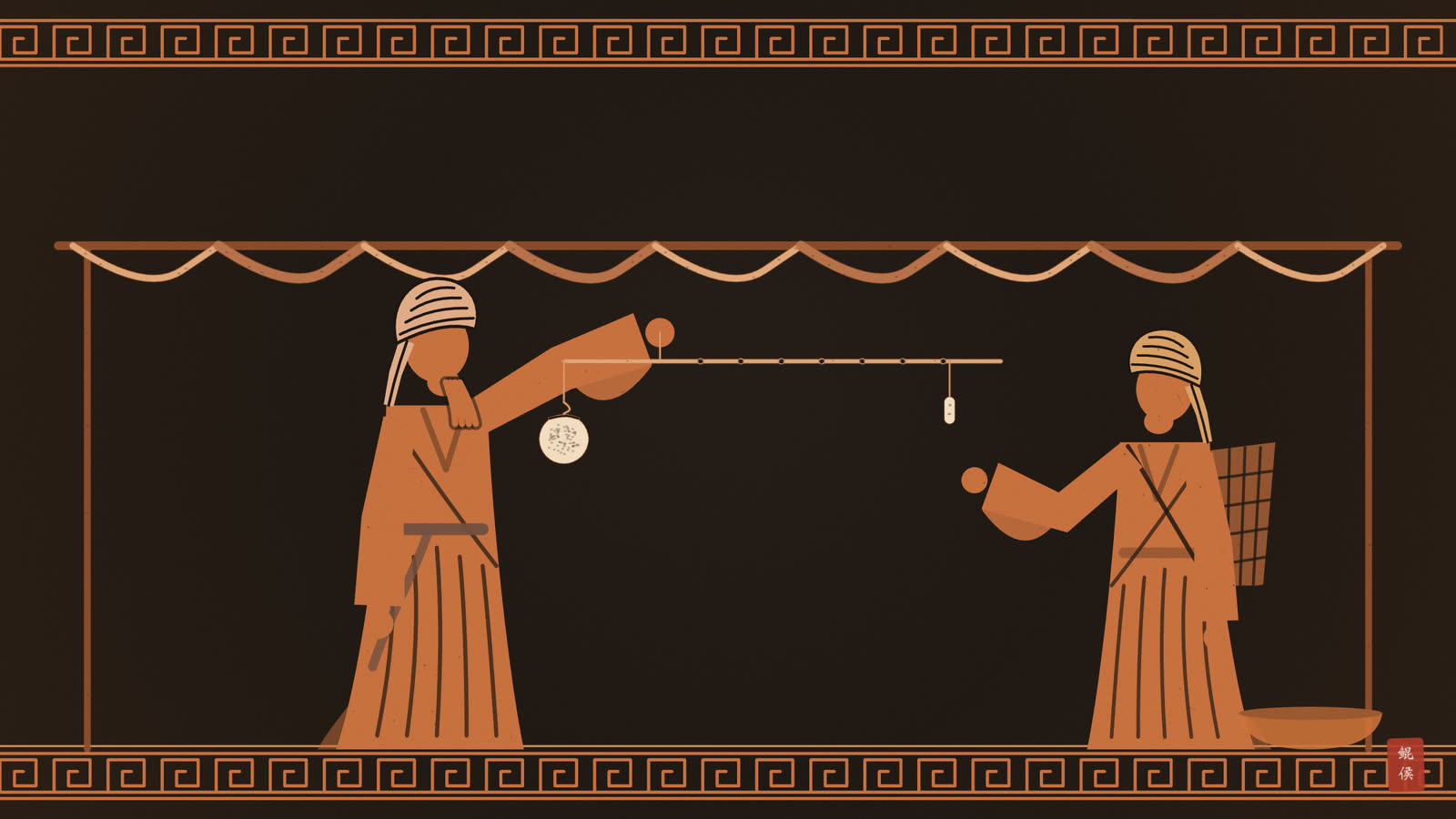
It is when the second and the third lie on one side. It is evident in the weights of the qarasṭūn, that is, the steelyard: the ratio of the distance of the hook from the point of suspension to the distance of the counterpoise from it is as the ratio of the weight of the counterpoise to the weight that balances it in the pan.
翻译点开
§52. What is the height of a figure?
第五十二问 何谓形的高?
The height of a figure is the greatest of the perpendiculars let fall from the angles of the figure onto its base or onto the base produced.
形的高,是从形的各角向它的底、或向底的延长线所作诸垂线中最大的那一条。
§53. What are similar triangles?
第五十三问 何谓相似三角形?
They are triangles in which every angle of the one is equal to its counterpart in the other, so that their corresponding sides are also proportional.
它们是这样的三角形:一个的每一个角都等于另一个中与之相应的角,因此它们相应的边也成比例。
§54. What is the ratio having a mean and two extremes?
第五十四问 何谓有中项与两端的比?
It occurs in a straight line divided into two parts such that the ratio of the smaller to the greater is as the ratio of that greater to the sum of both, that is, to the whole line.
它出现在一条分成两段的直线上:较小一段比较大一段,如同这较大一段比两段之和,也就是比全线。
§55. What is reciprocity in ratio?
第五十五问 何谓比的互反?
It is when the second and the third lie on one side. It is evident in the weights of the qarasṭūn, that is, the steelyard: the ratio of the distance of the hook from the point of suspension to the distance of the counterpoise from it is as the ratio of the weight of the counterpoise to the weight that balances it in the pan.
就是第二与第三位于同一侧。这在「卡拉斯通」也就是杆秤的重量上很明显:钩到提纽的距离比秤锤到提纽的距离,如同秤锤的重量比在秤盘里与它平衡的重量。
大意与图解点开
🔎 大意:形的高是诸角向底所作最长的垂线;相似三角形角角相等、边成比例;中外比是小段比大段如大段比全线;杆秤是互反比。
📖 术语
| 术语 | 英文原词 | 意思 |
|---|---|---|
| 形的高 | the height of a figure | 最长的那条垂线 |
| 相似三角形 | similar triangles | 角相等、边成比例 |
| 中外比 | the ratio having a mean and two extremes | 小比大如大比全 |
| 互反 | reciprocity | 第二第三在同侧 |
| 卡拉斯通 | qarasṭūn | 阿拉伯语的杆秤 |
🧭 图解与讲解
第五十二问定义形的高:从形的各角向底(或底的延长线)作垂线,其中最长的那条就是高。说「延长线」是为了钝角三角形,它的垂线有时落在底的外面。第五十三问的相似三角形,角角相等,所以对应边成比例;天文里量日影、测高远,用的都是相似三角形的道理。
〔图〕杆秤是互反比:钩距比锤距,如同锤重比盘中之重
〔图〕有中项与两端的比:小段比大段,如同大段比全线
第五十四问是「有中项与两端的比」:一条线分成两段,小段比大段,如同大段比全线(图二)。这就是后世所说的「黄金分割」,欧几里得用它来作正五边形。比鲁尼只给定义,不讲作法。
第五十五问的「互反」,比鲁尼用市场上最常见的杆秤(阿拉伯语「卡拉斯通」)来讲(图一)。提纽是悬点;一侧近处挂钩与秤盘,另一侧远处挂秤锤。钩距比锤距,如同锤重比盘中之重:离得近的一边重,离得远的一边轻。比例四项里,第二(锤距)与第三(锤重)同属秤锤一侧,所以叫「互反」,与上章第一比第二、第三比第四顺着排的比例方向相反。
这个例子很能代表比鲁尼的写法:抽象的名词总要找一件眼前之物来对照,前有水油之界、针尖,这里有杆秤。抄本此问下也画了一杆秤,标出悬点、秤锤与四项的次序,本站照它重画。
📖 术语
| 术语 | 英文原词 | 意思 |
|---|---|---|
| 形的高 | the height of a figure | 最长的那条垂线 |
| 相似三角形 | similar triangles | 角相等、边成比例 |
| 中外比 | the ratio having a mean and two extremes | 小比大如大比全 |
| 互反 | reciprocity | 第二第三在同侧 |
| 卡拉斯通 | qarasṭūn | 阿拉伯语的杆秤 |
🧭 图解与讲解
第五十二问定义形的高:从形的各角向底(或底的延长线)作垂线,其中最长的那条就是高。说「延长线」是为了钝角三角形,它的垂线有时落在底的外面。第五十三问的相似三角形,角角相等,所以对应边成比例;天文里量日影、测高远,用的都是相似三角形的道理。
第五十四问是「有中项与两端的比」:一条线分成两段,小段比大段,如同大段比全线(图二)。这就是后世所说的「黄金分割」,欧几里得用它来作正五边形。比鲁尼只给定义,不讲作法。
第五十五问的「互反」,比鲁尼用市场上最常见的杆秤(阿拉伯语「卡拉斯通」)来讲(图一)。提纽是悬点;一侧近处挂钩与秤盘,另一侧远处挂秤锤。钩距比锤距,如同锤重比盘中之重:离得近的一边重,离得远的一边轻。比例四项里,第二(锤距)与第三(锤重)同属秤锤一侧,所以叫「互反」,与上章第一比第二、第三比第四顺着排的比例方向相反。
这个例子很能代表比鲁尼的写法:抽象的名词总要找一件眼前之物来对照,前有水油之界、针尖,这里有杆秤。抄本此问下也画了一杆秤,标出悬点、秤锤与四项的次序,本站照它重画。
§56. What are 'power' and 'length'?
Power is the square, and length is its side. So when it is said that such-and-such a line is equal in power to two lines such-and-such, it means that its square is equal to their two squares.
§57. What is a cube?
It is a solid figure, like a die, enclosed by six squares on its six sides.
§58. What is a prism?
It is a figure enclosed on its sides by three square or oblong surfaces, and above and below by two triangles. Sometimes the square is a rhombus, or the oblong a rhomboid.
翻译点开
§56. What are 'power' and 'length'?
第五十六问 何谓「幂」与「长」?
Power is the square, and length is its side. So when it is said that such-and-such a line is equal in power to two lines such-and-such, it means that its square is equal to their two squares.
幂就是正方形,长就是它的边。所以说某条线在幂上等于某某两条线,意思是它的正方形等于那两条线的两个正方形之和。
§57. What is a cube?
第五十七问 何谓立方体?
It is a solid figure, like a die, enclosed by six squares on its six sides.
它是一个立体形,像骰子一样,六面由六个正方形围成。
§58. What is a prism?
第五十八问 何谓棱柱?
It is a figure enclosed on its sides by three square or oblong surfaces, and above and below by two triangles. Sometimes the square is a rhombus, or the oblong a rhomboid.
它是这样的形:侧面由三个正方形或长方形的面围成,上下由两个三角形围成。有时正方形换作菱形,或长方形换作似菱形。
大意与图解点开
🔎 大意:幂是正方形,长是它的边;一线在幂上等于两线,即其正方形等于两正方形之和。立方体由六个正方形围成,棱柱上下为三角形。
📖 术语
| 术语 | 英文原词 | 意思 |
|---|---|---|
| 幂 | 'power' | 即正方形 |
| 长 | 'length' | 即正方形的边 |
| 在幂上等于 | equal in power to | 正方形相等 |
| 立方体 | cube | 六个正方形围成 |
| 棱柱 | prism | 上下两个三角形 |
🧭 图解与讲解
第五十六问是一对很古老的名词:「幂」与「长」。幂就是正方形,长就是它的边。说一条线「在幂上等于」两条线,意思是它的正方形等于那两条线的正方形之和。最典型的例子是直角三角形:最大边的正方形等于两小边正方形之和,图一用三、四、五的直角三角形示意,九加十六得二十五。原文只给定义,例子是本站加的。
〔图〕幂就是正方形,长就是它的边;一线在幂上等于两线,即它的正方形等于两正方形之和
〔图〕立方体由六个正方形围成,像骰子;棱柱侧面三个方形、上下两个三角形
「幂」这个字今天还在用,乘方叫「幂」,就是从正方形来的。比鲁尼在卷二讲算术时还会讲平方与开方,那时「幂」与「长」就换成数的说法:一个数自乘是它的平方,那个数是它的根。几何的「线乘线」(上章第三十二问)、这里的「幂与长」、算术的平方与根,是同一件事的三种讲法。
第五十七、五十八问由平面进到立体。立方体像骰子,六面都是正方形;棱柱的侧面是三个正方形或长方形,上下是两个三角形,侧面也可以是菱形或似菱形,那就是被推斜的棱柱(图二)。下一问讲圆柱,结构与棱柱相同,只是底换成了圆。
📖 术语
| 术语 | 英文原词 | 意思 |
|---|---|---|
| 幂 | 'power' | 即正方形 |
| 长 | 'length' | 即正方形的边 |
| 在幂上等于 | equal in power to | 正方形相等 |
| 立方体 | cube | 六个正方形围成 |
| 棱柱 | prism | 上下两个三角形 |
🧭 图解与讲解
第五十六问是一对很古老的名词:「幂」与「长」。幂就是正方形,长就是它的边。说一条线「在幂上等于」两条线,意思是它的正方形等于那两条线的正方形之和。最典型的例子是直角三角形:最大边的正方形等于两小边正方形之和,图一用三、四、五的直角三角形示意,九加十六得二十五。原文只给定义,例子是本站加的。
「幂」这个字今天还在用,乘方叫「幂」,就是从正方形来的。比鲁尼在卷二讲算术时还会讲平方与开方,那时「幂」与「长」就换成数的说法:一个数自乘是它的平方,那个数是它的根。几何的「线乘线」(上章第三十二问)、这里的「幂与长」、算术的平方与根,是同一件事的三种讲法。
第五十七、五十八问由平面进到立体。立方体像骰子,六面都是正方形;棱柱的侧面是三个正方形或长方形,上下是两个三角形,侧面也可以是菱形或似菱形,那就是被推斜的棱柱(图二)。下一问讲圆柱,结构与棱柱相同,只是底换成了圆。
§59. What is a right cylinder?
It is an elongated round body whose two bases, the lower and the upper, are two equal and parallel circles. Its axis is the shortest line between the centres of the two bases, and its side is the shortest line between their circumferences. It is generated by revolving a line, standing perpendicular on the two bases, between their circumferences.
§60. What is an oblique cylinder?
It is one whose axis does not stand perpendicular on the plane of the base [corrected: MS has 'stands perpendicular']. Sometimes the bases of a cylinder are not circles but two similar and equal figures, such as two squares or two triangles or similar polygons.
§61. What is a cone?
It is a body that begins from a base, which is a circle or any figure whatever, and ends at a point. It has a cylinder whose base is the base of the cone and the centre of whose other base is the vertex of the cone. If that cylinder is right, the cone is called a right cone; if it is oblique, an oblique cone. A cone is always a third of its cylinder. The axis of a cone is the straight line between its vertex and the centre of its base, and its side is the line between its vertex and the circumference of the base.
翻译点开
§59. What is a right cylinder?
第五十九问 何谓直圆柱?
It is an elongated round body whose two bases, the lower and the upper, are two equal and parallel circles. Its axis is the shortest line between the centres of the two bases, and its side is the shortest line between their circumferences. It is generated by revolving a line, standing perpendicular on the two bases, between their circumferences.
它是一个长圆的物体,上下两底是两个相等且平行的圆。它的轴是两底圆心之间最短的线;它的侧线是两底圆周之间最短的线。它由一条垂立于两底之上的线,沿两底圆周旋转而生成。
§60. What is an oblique cylinder?
第六十问 何谓斜圆柱?
It is one whose axis does not stand perpendicular on the plane of the base [corrected: MS has 'stands perpendicular']. Sometimes the bases of a cylinder are not circles but two similar and equal figures, such as two squares or two triangles or similar polygons.
它的轴不垂立于底面之上〔抄本作「垂立」,据文义改正〕。有时圆柱的两底不是圆,而是两个相似而相等的形,如两个正方形、两个三角形或类似的多边形。
§61. What is a cone?
第六十一问 何谓圆锥?
It is a body that begins from a base, which is a circle or any figure whatever, and ends at a point. It has a cylinder whose base is the base of the cone and the centre of whose other base is the vertex of the cone. If that cylinder is right, the cone is called a right cone; if it is oblique, an oblique cone. A cone is always a third of its cylinder. The axis of a cone is the straight line between its vertex and the centre of its base, and its side is the line between its vertex and the circumference of the base.
它是一个从一个底开始、止于一点的物体,底是圆或任何一种形。它有一个圆柱,圆柱的底就是圆锥的底,圆柱另一底的中心就是圆锥的顶点。那圆柱若是直的,圆锥就叫作直圆锥;若是斜的,就叫作斜圆锥。圆锥总是它的圆柱的三分之一。圆锥的轴是顶点与底面中心之间的直线,它的侧线是顶点与底圆周之间的线。
大意与图解点开
🔎 大意:圆柱两底是相等平行的圆,轴垂直于底为直、不垂直为斜;圆锥从底收到一点,按其所属圆柱分直斜,总是圆柱的三分之一。
📖 术语
| 术语 | 英文原词 | 意思 |
|---|---|---|
| 直圆柱 | right cylinder | 轴垂直于底 |
| 斜圆柱 | oblique cylinder | 轴不垂直于底 |
| 轴 | axis | 两底圆心之间的线 |
| 侧线 | side | 两底圆周之间的线 |
| 圆锥 | cone | 由底收到一点 |
🧭 图解与讲解
第五十九问定义直圆柱:两底是相等且平行的圆,连接两圆心的最短线是轴,连接两圆周的最短线是侧线;一条垂立于两底的线沿圆周绕一圈,就扫出圆柱的侧面(图一左)。第六十问的斜圆柱,轴不垂直于底面(图一右)。抄本这里写的是「垂立」,正好说反了,显然漏了一个否定词;英译依文义改正,并在原文中注明。比鲁尼还补了一句:圆柱的底不一定是圆,两个相等相似的正方形、三角形也可以,那其实就是上一问的棱柱。
〔图〕圆柱两底是相等平行的圆:轴垂直于底为直圆柱,不垂直为斜圆柱
〔图〕圆锥与它的圆柱同底,顶点在圆柱另一底的中心;圆锥总是它圆柱的三分之一
第六十一问的圆锥定义很巧:每个圆锥都配一个圆柱,圆柱与圆锥同底,圆柱另一底的中心就是圆锥的顶点。圆柱直,圆锥就直;圆柱斜,圆锥就斜(图二)。「圆锥总是它的圆柱的三分之一」,说的是体积,这是古希腊数学家早已证明的结果,比鲁尼在这里只是当作常识交代。
圆柱、圆锥为什么要在占星入门书里讲?因为天文学的许多东西都与它们有关:月食时地球投向月亮的影子就是一个圆锥,日晷与天球的种种投影也离不开圆柱与圆锥。下一问的圆锥截线,又是理解日晷影端行迹的底子。
📖 术语
| 术语 | 英文原词 | 意思 |
|---|---|---|
| 直圆柱 | right cylinder | 轴垂直于底 |
| 斜圆柱 | oblique cylinder | 轴不垂直于底 |
| 轴 | axis | 两底圆心之间的线 |
| 侧线 | side | 两底圆周之间的线 |
| 圆锥 | cone | 由底收到一点 |
🧭 图解与讲解
第五十九问定义直圆柱:两底是相等且平行的圆,连接两圆心的最短线是轴,连接两圆周的最短线是侧线;一条垂立于两底的线沿圆周绕一圈,就扫出圆柱的侧面(图一左)。第六十问的斜圆柱,轴不垂直于底面(图一右)。抄本这里写的是「垂立」,正好说反了,显然漏了一个否定词;英译依文义改正,并在原文中注明。比鲁尼还补了一句:圆柱的底不一定是圆,两个相等相似的正方形、三角形也可以,那其实就是上一问的棱柱。
第六十一问的圆锥定义很巧:每个圆锥都配一个圆柱,圆柱与圆锥同底,圆柱另一底的中心就是圆锥的顶点。圆柱直,圆锥就直;圆柱斜,圆锥就斜(图二)。「圆锥总是它的圆柱的三分之一」,说的是体积,这是古希腊数学家早已证明的结果,比鲁尼在这里只是当作常识交代。
圆柱、圆锥为什么要在占星入门书里讲?因为天文学的许多东西都与它们有关:月食时地球投向月亮的影子就是一个圆锥,日晷与天球的种种投影也离不开圆柱与圆锥。下一问的圆锥截线,又是理解日晷影端行迹的底子。
§62. What are the sections of a cone?
If a cone is cut by a plane passing through its vertex, this produces in the cone a rectilinear triangle. If the plane cuts it parallel to its base, the section is a circle. If it cuts it parallel to one of its sides, the section is called a parabola. If the cutting plane is not parallel to the side but meets it inside the cone towards the base, either as it is or when produced straight on, the section is called an ellipse; and if it meets it towards the vertex when produced in that direction, the section is called a hyperbola. There are no sections of the cone other than these, except in the oblique cone: if a plane not parallel to the base cuts it, and its angles are equal to the angles of the base, the section is also a circle.
翻译点开
§62. What are the sections of a cone?
第六十二问 圆锥的截线有哪些?
If a cone is cut by a plane passing through its vertex, this produces in the cone a rectilinear triangle. If the plane cuts it parallel to its base, the section is a circle. If it cuts it parallel to one of its sides, the section is called a parabola. If the cutting plane is not parallel to the side but meets it inside the cone towards the base, either as it is or when produced straight on, the section is called an ellipse; and if it meets it towards the vertex when produced in that direction, the section is called a hyperbola. There are no sections of the cone other than these, except in the oblique cone: if a plane not parallel to the base cuts it, and its angles are equal to the angles of the base, the section is also a circle.
圆锥若被一个经过顶点的平面所截,就在圆锥中生出一个直线三角形。平面若平行于底而截它,截口就是圆。若平行于它的一条侧线而截它,截口叫作抛物线。截面若不平行于侧线,而是在圆锥内部朝底的方向与侧线相遇——不论照原样还是笔直延长之后——截口叫作椭圆;若朝顶点的方向延长之后才与侧线相遇,截口叫作双曲线。除此以外,圆锥没有别的截线,只有斜圆锥例外:若一个不平行于底的平面截它,而所成的角等于底的角,截口也是圆。
大意与图解点开
🔎 大意:平面截圆锥:过顶点成三角形,平行于底成圆,平行于侧线成抛物线,朝底与侧线相遇成椭圆,朝顶相遇成双曲线。
📖 术语
| 术语 | 英文原词 | 意思 |
|---|---|---|
| 截线 | sections of a cone | 平面截圆锥所得 |
| 抛物线 | parabola | 截面平行于侧线 |
| 椭圆 | ellipse | 截面朝底与侧线相遇 |
| 双曲线 | hyperbola | 截面朝顶与侧线相遇 |
| 直线三角形 | rectilinear triangle | 截面过顶点 |
🧭 图解与讲解
第六十二问是卷一几何前半的收尾:用一个平面去截圆锥,截口有几种(图一)。平面过顶点,截出三角形;平行于底,截出圆;平行于一条侧线,截出抛物线;不平行于侧线、朝底的方向与侧线相遇,截出椭圆;要朝顶点的方向延长、越过顶点才与侧线相遇,截出双曲线。抄本此问下画了直圆锥与斜圆锥,各标出圆、椭圆、抛物线、双曲线的截线。
〔图〕平面截圆锥:过顶点成三角形,平行于底成圆,另有抛物线、椭圆、双曲线三种
| 截面怎样截 | 截口 |
|---|---|
| 经过顶点 | 直线三角形 |
| 平行于底 | 圆 |
| 平行于一条侧线 | 抛物线 |
| 不平行于侧线,在圆锥内朝底的方向与侧线(或其延长)相遇 | 椭圆 |
| 朝顶点的方向延长之后才与侧线相遇 | 双曲线 |
| 斜圆锥:不平行于底,而所成之角等于底角 | 也是圆 |
最后一句是专讲斜圆锥的例外:一个不平行于底的平面,如果与侧面所成的角等于底与侧面所成的角,截出来的也是圆。这在希腊几何里叫「反向截面」,阿波罗尼奥斯的《圆锥曲线论》专门讨论过。抄本斜圆锥图旁有三个小字,似可读作「角度交错的截面」,正与这一说相应。
这些曲线对学占星的人并不遥远。日晷上,影子的端点在一天里画出的路线,一般就是一条圆锥截线;星盘把天球画到平面上,也要先懂圆与截面的关系,卷七讲星盘时再细说。本章讲到这里,点、线、面、体的名词都备齐了,下一章转入球与球面上的大圆、小圆,开始为天球作准备。
📖 术语
| 术语 | 英文原词 | 意思 |
|---|---|---|
| 截线 | sections of a cone | 平面截圆锥所得 |
| 抛物线 | parabola | 截面平行于侧线 |
| 椭圆 | ellipse | 截面朝底与侧线相遇 |
| 双曲线 | hyperbola | 截面朝顶与侧线相遇 |
| 直线三角形 | rectilinear triangle | 截面过顶点 |
🧭 图解与讲解
第六十二问是卷一几何前半的收尾:用一个平面去截圆锥,截口有几种(图一)。平面过顶点,截出三角形;平行于底,截出圆;平行于一条侧线,截出抛物线;不平行于侧线、朝底的方向与侧线相遇,截出椭圆;要朝顶点的方向延长、越过顶点才与侧线相遇,截出双曲线。抄本此问下画了直圆锥与斜圆锥,各标出圆、椭圆、抛物线、双曲线的截线。
| 截面怎样截 | 截口 |
|---|---|
| 经过顶点 | 直线三角形 |
| 平行于底 | 圆 |
| 平行于一条侧线 | 抛物线 |
| 不平行于侧线,在圆锥内朝底的方向与侧线(或其延长)相遇 | 椭圆 |
| 朝顶点的方向延长之后才与侧线相遇 | 双曲线 |
| 斜圆锥:不平行于底,而所成之角等于底角 | 也是圆 |
最后一句是专讲斜圆锥的例外:一个不平行于底的平面,如果与侧面所成的角等于底与侧面所成的角,截出来的也是圆。这在希腊几何里叫「反向截面」,阿波罗尼奥斯的《圆锥曲线论》专门讨论过。抄本斜圆锥图旁有三个小字,似可读作「角度交错的截面」,正与这一说相应。
这些曲线对学占星的人并不遥远。日晷上,影子的端点在一天里画出的路线,一般就是一条圆锥截线;星盘把天球画到平面上,也要先懂圆与截面的关系,卷七讲星盘时再细说。本章讲到这里,点、线、面、体的名词都备齐了,下一章转入球与球面上的大圆、小圆,开始为天球作准备。
原文为公有领域古籍;翻译、印象画与图文解读由 AI 辅助生成,鲲侯审校。